
The Hierophant: A man sits on a throne holding a scepter in one hand and giving some kind of sign with his other. He is dressed in ceremonial robes and wears a crown on his head. Two men kneel at his feet looking subservient.
So. Continue reading

The Hierophant: A man sits on a throne holding a scepter in one hand and giving some kind of sign with his other. He is dressed in ceremonial robes and wears a crown on his head. Two men kneel at his feet looking subservient.
So. Continue reading
The historic conclave to choose the next Catholic Pope began in earnest yesterday. So far only black smoke has risen from the Sistine Chapel chimney signalling that the 115 cardinals inside have yet to agree on who shall be leader of the billion-strong congregation. The world awaits their decision in suspense outside the chapel doors.
Traditionally the Pope is represented by this card in Tarot…
 Following on from my post about the Gotye Remix ‘Some Study That I Used To Know’ I stumbled across a site listing ’49 Things You Learned In School That Are Completely Useless.’ The list includes:
Bill Gates gave a speech at a high school recently in which he talked about how feel-good politically correct teachings had created a generation of kids with no concept of reality which sets them up for failure in the real world. He outlined eleven rules students would not learn in school but should.
Rule 1: Continue reading
The Hierophant: A man sits on a throne holding a sceptre in one hand and giving some kind of sign with his other. He is dressed in ceremonial robes and wears a crown on his head. Two men kneel at his feet looking subservient.
Some peeps call this fellow Continue reading
I like to contemplate Tarot cards in groups as well as on their own. The meaning of a card can become clearer when you see what lies either side of it in the deck. Especially with the Life Lesson (Major Arcana) cards which as I have said refer to the significant experiences we have as human beings. Let’s look at an example shall we?
Here we have: The Empress. The Emperor. The Hierophant.
Which on one level represent: Your mum. Your dad. Your teachers.
On another: Play. Discipline. Forming ideas.
These life experiences roughly initiate at: Age 0-2. Age 2-5. Age 5+.
In other words these cards represent you as: A baby. A preschooler. In primary school (as we call the first formal level of learning in Australia).
By lining up The Empress, The Emperor and The Hierophant side by side you can see that they represent the natural sequence of events in early childhood development. This trick helps me understand the cards better. Does it help you?
P.S. I suspect my posts are getting shorter as the school term drags on. That’s cause teaching sucks the life force out of me. There ain’t much left in the tank at the end of the day after I’ve completed all my must-dos (which tonight included a load of washing, dishes, two car trips for the wee ones not to mention shopping and dinner.) But I hope you still find what I have to say interesting and helpful (and that I’m still making sense). That’s my aim. And if there’s anything in particular you’d like me to chat about wrt Tarot cards please let me know. Cheers!
The Major Arcana cards read like a book that follows the journey of a human soul through life.
The first volume covers childhood:
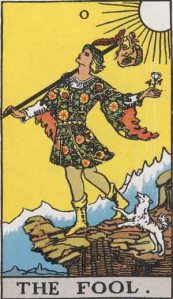
The Fool – The soul waiting to be born
 The Magician – The newborn who seems perfect in every way and has so much potential.
 The High Priestess – The baby living off instinct during the first months and years.
 The Empress – The child at play
 The Emperor – The child being disciplined
The Hierophant – The school child forming ideas about the world
 The Lovers – The teenager beginning to make choices about what they want and who they want to be with.
 The Chariot – The young adult striving for success.
That’s one way of looking at it anyway. There are many more. That’s the beautiful confusing thing about Tarot. It’s like a diamond. Every time you turn it in your hand you see another side.
What about you? What’s your take on the first 8 cards of the Holy Book of Tarot?
 The Tarot Teaclub